The humble twist drill bit is one of the most common cutting tools on Earth, and among twist drills, High-Speed Steel (HSS) remains the undisputed king for general-purpose drilling. Whether you're a professional machinist, a home DIY enthusiast, or someone restoring vintage machinery, chances are most of the holes you’ve ever made were drilled with an HSS twist drill bit. Renowned for their versatility, durability, and efficiency, these bits are designed to tackle a wide range of materials, from wood to metal. But what exactly sets HSS twist drill bits apart from the rest, and how can you maximize their potential in your own projects?
What "HSS" Actually Means
HSS = High-Speed Steel. It is not a single alloy. It is a family of tool steels that can run red-hot and still hold a cutting edge. Plain carbon steel softens and dulls at 200 °C. That 350–400 °C difference is why HSS conquered the 20th century and refuses to die in the 21st.
The classic grade that made the reputation is called M2 (sometimes stamped 6542 in Europe/Asia). Chemical makeup (approximate):
- 0.85 % carbon
- 4 % chromium
- 5 % molybdenum
- 6 % tungsten
- 2 % vanadium
- balance iron
Other common HSS grades you'll see:
- M1 – slightly less molybdenum, cheaper, slightly less heat resistant
- M7 – more vanadium, better for abrasive materials
- M35 – 5 % cobalt added (often stamped HSS-Co5 or HSS-E)
- M42 – 8–10 % cobalt (HSS-Co8/Co10) – the king for hardcore stainless and heat-resistant alloys
Rule of thumb: No cobalt marking → M2 or similar → perfect for mild steel, aluminium, wood, plastics "HSS-Co" or "HSS-E" → has cobalt → eats stainless, titanium, Inconel for breakfast If the packet just says "HSS" with no further letters → assume plain M2.
An HSS twist drill bit is a rotary cutting tool made from High-Speed Steel that removes material by combining rotation and axial feed to produce round holes in almost any solid material.
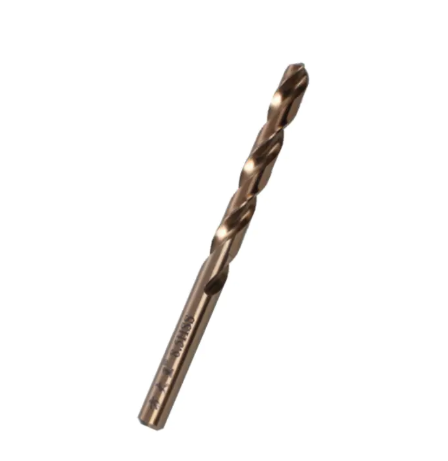
The "twist" refers to its helical flutes — the spiral grooves that form the cutting edges (lips), evacuate chips, and allow cutting fluid to reach the tip. Virtually all modern general-purpose drill bits are twist drills; other designs (spade, Forstner, step, gun drills, etc.) exist for specialised jobs, but when someone says “drill bit” they almost always mean an HSS twist drill.
Key characteristics that define an HSS twist drill bit:
- Made primarily from high-speed steel (see next section)
- Two (occasionally three or four) helical flutes
- A conical point with two cutting lips
- Designed to be re-sharpened many times
- Capable of running at 2–4× the cutting speed of carbon-steel drills without losing hardness
Available in diameters from <0.1 mm to over 100 mm and in lengths from stub to extra-long
In short: if it's shiny or gold/black, has spiral flutes, a pointed tip, and came in that plastic index from the hardware store — 99% chance it’s an HSS twist drill bit.
Why HSS Twist Drills Are Almost Always HSS
- Cost — A good M2 bit costs pennies in bulk; carbide is 10–30× more expensive.
- Toughness — HSS can flex slightly without snapping. Carbide is brittle and chips easily on interrupted cuts or in hand-held drills.
- Resharpening — You can hand-sharpen HSS on a bench grinder forever. Sharpening carbide properly requires diamond wheels and precise fixtures.
- Availability — Every hardware shop on the planet stocks HSS jobber drills from 0.1 mm to 50 mm+.
Surface Treatments and Coatings
Plain bright-finished HSS is still sold, but most bits today have one of these coatings:
- Black oxide – cheap heat treatment that adds a little lubricity and corrosion resistance.
- TiN (gold color) – titanium nitride; reduces friction and increases surface hardness. Good for cast iron, aluminum, mild steel.
- TiCN (blue-gray) – harder than TiN; better for abrasive materials.
- TiAlN (violet-black) – best heat resistance; used on M42 bits for stainless and titanium.
- ZrN, AlCrN, etc. – specialty coatings for specific materials.
Note: The coating only protects the outside. Once you sharpen the bit, the coating is gone from the cutting edge, so performance drops back to the base HSS properties.
When HSS Twist Drills Excel
HSS remains the first choice for:
- Carbon and low-alloy steels
- Stainless steel (with cobalt grades and proper coolant)
- Cast iron, ductile iron
- Aluminum, brass, bronze, copper
- Plastics and wood
- Maintenance, repair, and field work
Applications Where You Should Upgrade to Carbide or Indexable Tools
- Hardened steels above 45 HRC
- Aerospace superalloys (Inconel, Hastelloy, Waspaloy)
- High-volume production (>500 identical holes)
- Glass-filled composites or carbon fiber
- Extremely high precision-tolerant holes (±0.01 mm)
Professional Tips for Maximum Life and Performance
- Always use cutting fluid or oil on metals (except cast iron and brass).
- Reduce speed by 30–50 % and increase feed pressure when drilling stainless.
- Use peck cycles on holes deeper than 3× diameter.
- Never use hammer mode on standard HSS bits.
- Re-sharpen before the edge completely dulls — a sharp HSS bit often outperforms a new low-quality one.
How to Use HSS Bits Correctly
- Use cutting oil or coolant on steel; light oil on aluminum; nothing or wax on wood/plastic.
- Speed: General rule – slower for harder/tougher materials, faster for soft. Example for 1/4" bit in mild steel: 800–1200 RPM with hand drill, 2000–3000 RPM on drill press.
- Feed: Firm, steady pressure. Too light and you work-harden the surface; too heavy and you snap the bit.
- Peck drill in deep holes (>3× diameter) to clear chips.
- Back off the pressure the instant the point breaks through to avoid grabbing.
- Split-point bits need almost no center-punch mark on flat surfaces.
When to Upgrade from HSS
- Drilling hundreds of holes in stainless → cobalt HSS or carbide.
- Hardened steel or frequent breakage → solid carbide or carbide-insert indexable bits.
- CNC or production → almost always carbide.
- Precision holes in exotic alloys → carbide with through-coolant.
- For the average home shop, garage, or maintenance department, good cobalt HSS bits will still do 95 % of jobs perfectly well.
Storage & Maintenance Best Practices
- Store in drill indexes or blocks — never loose in a drawer
- Clean and lightly oil after use in corrosive environments
- Inspect for chipped edges or shank damage before each use
- Professional regrinding services can restore bits to "better-than-new" condition multiple times
The HSS twist drill bit has earned its place as the most trusted and versatile cutting tool in workshops worldwide—and for good reason. With the perfect balance of strength, heat resistance, affordability, and the ability to be sharpened multiple times, a quality HSS bit delivers precise, clean holes in steel, stainless, aluminum, cast iron, plastics, and wood, day after day.
Whether you're drilling a single repair hole on site or producing hundreds of parts in a busy shop, choosing the right grade, coating, and point style—combined with proper speeds, feeds, and cutting fluid—will give you faster work, longer bit life, and lower overall costs.





 4008-253-777


