



Industry News
Home / News / Industry News / What Safety Precautions Should Be Taken When Using Wood Cutting Saw Blade
Wood Cutting Saw Blades are common in many cutting environments. They appear simple, but they carry real risks when handled without care. Injuries often happen not because the tool is complex, but because small safety steps are ignored or rushed.
Modern workshops, small production sites, and home projects all face the same basic challenge. A saw blade works with speed and force. That combination requires attention, stable handling, and a clear routine. Safety is not a single action. It is a chain of habits that work together during use.
Most incidents around saw blades are linked to predictable situations. The tool itself does not change, but the way it is handled often does.
Common reasons include distraction, rushed setup, unstable material placement, and worn cutting edges. Even a short moment of inattention can lead to contact with a moving blade or unexpected material movement.
Another frequent cause is incorrect alignment. When the blade and material are not properly positioned, resistance increases. That can lead to sudden shifts during cutting.
Environmental factors also play a role. A cluttered workspace or poor lighting can reduce reaction time and visibility. These conditions slowly increase risk without being immediately noticeable.
Safety discussions often focus on the blade, but the surrounding conditions matter just as much.
Before any cutting begins, a short inspection routine can reduce many risks. This step is often overlooked when the focus is on productivity or speed.
The blade should be checked for visible wear. Chips, cracks, or uneven edges can affect stability during use. Even small irregularities may change how the blade moves through material.
The tool housing and protective elements should also be examined. Loose parts or missing covers increase exposure to moving components.
Material preparation is another important point. The object being cut should be stable and secured. If it shifts during cutting, control is reduced.
A simple checklist can help organize this stage:
| Check Area | What to Look For | Purpose |
|---|---|---|
| Blade surface | Damage or wear | Prevent unstable cutting |
| Tool structure | Loose or missing parts | Maintain safe operation |
| Material setup | Secure positioning | Reduce movement risk |
| Work area | Clean and clear space | Improve visibility and control |
This stage is not about complexity. It is about removing small uncertainties before movement begins.
The environment around a saw blade is part of the safety system. A well-prepared space supports stable movement and reduces unexpected interruptions.
The surface where cutting takes place should remain firm and level. Shifting surfaces can affect alignment and increase vibration during operation.
Clear space around the cutting zone is also important. Tools, offcuts, and loose items should not be placed near the movement path. Even small objects can interfere with handling or become hazards.
Lighting plays a quiet but important role. Shadows or dim areas reduce visibility of both the blade and the material. Clear sightlines help maintain control during each motion.
Noise and distraction levels matter as well. Sudden interruptions can break focus during active cutting. A controlled environment helps maintain consistent attention.
The goal of preparation is not perfection. It is predictability. A predictable space reduces reaction delays.
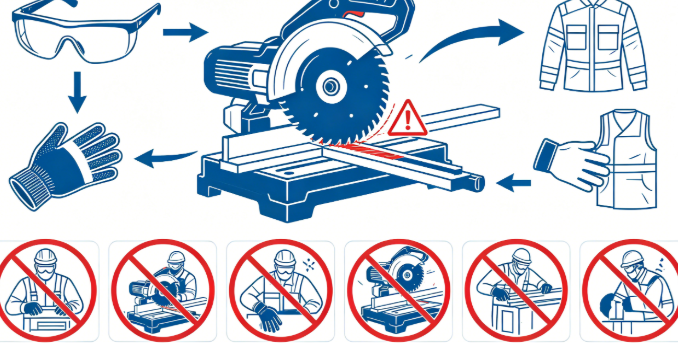
Personal protection is often seen as a final layer, but it works best when combined with proper setup and handling.
Protective gear is designed to reduce direct exposure to moving parts or flying material fragments. It does not replace careful operation, but it reduces the impact of unexpected contact.
Common protective elements include:
Each item plays a specific role. Together, they form a basic protective barrier between the operator and the cutting process.
Protection is not only about equipment. It is also about consistency in use. Skipping steps occasionally can reduce overall safety effectiveness.
Handling during operation requires steady movement and controlled positioning. The blade should always be approached with awareness of its movement direction and cutting path.
Material feeding should be smooth rather than forced. Excess pressure can change how the blade interacts with the surface. That can lead to resistance or sudden movement.
Hands should remain positioned away from the direct cutting line. Tools designed for guiding material can help maintain distance and control.
It is also important to avoid adjusting material while the blade is active. Even small corrections should be made after stopping movement completely.
A common principle in handling is simple: control should remain constant, not reactive. Sudden adjustments often create unnecessary risk.
Blade condition directly affects how stable the cutting process feels. A worn or uneven blade does not move through material consistently.
When the edge is no longer uniform, resistance changes during rotation or movement. That can create vibration or slight pulling effects on the material being cut.
Regular cleaning helps maintain smoother contact with surfaces. Residue buildup can interfere with movement and reduce control.
Storage also matters. Blades kept in unstable conditions may develop surface changes over time. Even when not in use, their condition can slowly shift.
The relationship between blade condition and safety is continuous. A stable blade supports stable handling.
Safety is not built from one-time actions. It develops through repeated habits that become part of routine work.
Operators often build their own rhythm over time. That rhythm should include short pauses before starting, quick checks of setup, and awareness during movement.
Fatigue is another factor that affects consistency. As attention decreases, small mistakes become more likely. Short breaks can help maintain focus during longer tasks.
Communication also matters in shared environments. When multiple people are working near cutting areas, awareness of movement patterns becomes important.
A simple habit structure can help maintain consistency:
| Habit Area | Practice | Effect |
|---|---|---|
| Pre-check routine | Quick inspection before use | Reduces unexpected issues |
| Focus control | Avoid distractions during cutting | Improves accuracy |
| Material handling | Steady and controlled movement | Reduces sudden shifts |
| Post-use review | Brief check after operation | Helps maintain equipment condition |
These habits are not complex. They rely on repetition and attention over time.
After cutting is complete, the blade and surrounding area still require attention. The process does not end when movement stops.
The blade should be allowed to come to a full stop before any contact. Attempting to handle it too early can lead to unnecessary risk.
Material remnants should be removed carefully. Sharp edges may remain on cut surfaces, so handling should be controlled.
The blade itself can be cleaned to remove residue from use. This helps maintain smoother operation in future tasks.
Storage is also part of the after-use stage. A stable and secure place reduces the chance of accidental contact and helps preserve blade condition.
Work areas should be reset to a neutral state. Removing scattered material supports safer conditions for the next operation.
Awareness is often the most important factor in safe blade use. Tools do not change during operation, but human attention does.
When focus shifts away from the task, reaction time slows. That delay can be enough to create risk in fast-moving environments.
Awareness includes understanding material behavior, recognizing resistance changes, and noticing small shifts in sound or movement.
It also involves recognizing limits. When conditions feel unstable, pausing the process can prevent escalation.
Safety around saw blades is not only physical. It is also observational. The ability to notice change during operation is part of the control system itself.
 4008-253-777
Industrial Zone, Furong Town, Yueqing City, Zhejiang Province, China


+86-0577-62298888
+86-0577-62299999

+86-0577-62295777
+86-0577-62297777
Copyright © Fangda Holding Co., Ltd. All Rights Reserved
Metal Drill Bit Sets Suppliers
