



Industry News
HSS metal hole saw are tools that often appear in metalworking and installation tasks where round openings are needed. In many workshops or site environments, they are not treated as complex equipment, but more like a routine cutting tool that gets picked up when a circular hole is required.
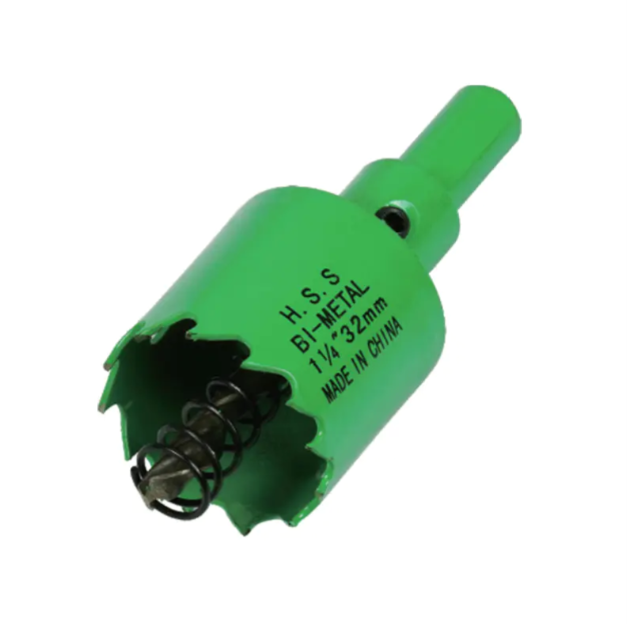
At first glance, it looks simple. A ring-shaped cutter attached to a drill. But once it starts working on metal surfaces, its behavior becomes more controlled and predictable compared to general cutting tools.
In practice, an HSS metal hole saw is mainly used when a clean round opening is needed without disturbing too much of the surrounding surface.
Typical situations include fitting pipes into metal panels, preparing entry points for wiring, or modifying sheet materials during installation work.
What makes it useful is not only the shape it creates, but the way it removes material. Instead of breaking through randomly, it follows a circular path and leaves a defined opening.
In many working environments, it is used when people want:
It is often chosen for jobs where appearance and fit both matter.
When the tool touches the surface, the first contact is usually gentle. After that, it slowly begins to trace a circle. The cutting does not happen all at once. It develops step by step as the tool rotates.
Metal does not give in easily, so the movement tends to feel steady rather than fast. The operator often notices that pressure needs to stay consistent. Too much force makes the tool unstable, while too little slows the progress.
As the cut deepens, the center piece remains intact until the full circle is completed. At that point, it separates and falls away or stays inside the tool.
The whole process feels more like guiding a shape than forcing a cut.
HSS metal hole saws are commonly used on a range of metal-based surfaces. Their behavior depends on surface hardness and thickness, but they are generally used for:
A simple comparison table helps explain usage behavior:
| Material Type | Cutting Behavior |
|---|---|
| Thin metal sheets | Smooth and controlled cutting |
| Medium metal surfaces | Steady removal with consistent edges |
| Hard alloy surfaces | Slower progress with more resistance |
| Layered materials | Requires careful alignment |
The key factor is not only the material type, but also how stable the tool remains during cutting.
The main reason is control. Metal cutting can easily become uneven if the tool is not stable. A hole saw helps reduce that risk by keeping the cutting path circular and consistent.
Instead of carving through a whole area, it focuses on a defined ring. That makes the result easier to predict.
In daily work, people tend to prefer it when:
It is less about speed and more about reducing correction work afterward.
The structure is simple, but its behavior is quite specific. The outer edge is the part that actually contacts the material. As the tool rotates, this edge gradually removes material along a fixed circle.
Inside the tool, the removed material has space to collect instead of spreading across the surface. That helps keep the cutting area clearer than many open cutting methods.
The motion is continuous, and the result depends heavily on how steady the tool is kept during operation. Small shifts in direction can affect the roundness of the opening.
At a basic level, both tools create holes, but they approach the task differently.
A drill bit works from the center and pushes outward. A hole saw works from the outside edge and defines the shape directly.
In real working situations, this leads to different choices:
When a cleaner round shape is needed, operators often lean toward the hole saw because it reduces irregular edges.
The result is not only about the tool itself. How it is handled during use matters just as much.
If the tool is slightly unstable, the circle may not stay even. If pressure changes too often, the surface may show uneven marks.
In practice, better results usually come from:
It is less about technique complexity and more about maintaining a steady rhythm during work.
Over time, the cutting edge naturally becomes less sharp. This is not sudden. It shows gradually through slower cutting and more resistance during entry.
Operators usually notice small changes first. The tool starts to feel slightly heavier when it touches the surface, and progress becomes slower than before.
Even then, it still continues to work, but the handling style often changes slightly to compensate for wear.
This is part of normal use in metalworking environments where tools are reused across different tasks.
Even with many modern cutting tools available, HSS metal hole saws remain common because they are simple and predictable.
They do not require complicated setup. They work in a straightforward way. And they produce results that are easy to understand and repeat.
In many environments, that kind of consistency is more useful than complexity.
It fits into daily work where circular openings are needed without spending too much time adjusting tools or correcting edges afterward.

 4008-253-777
Industrial Zone, Furong Town, Yueqing City, Zhejiang Province, China


+86-0577-62298888
+86-0577-62299999

+86-0577-62295777
+86-0577-62297777
Copyright © Fangda Holding Co., Ltd. All Rights Reserved
Metal Drill Bit Sets Suppliers
