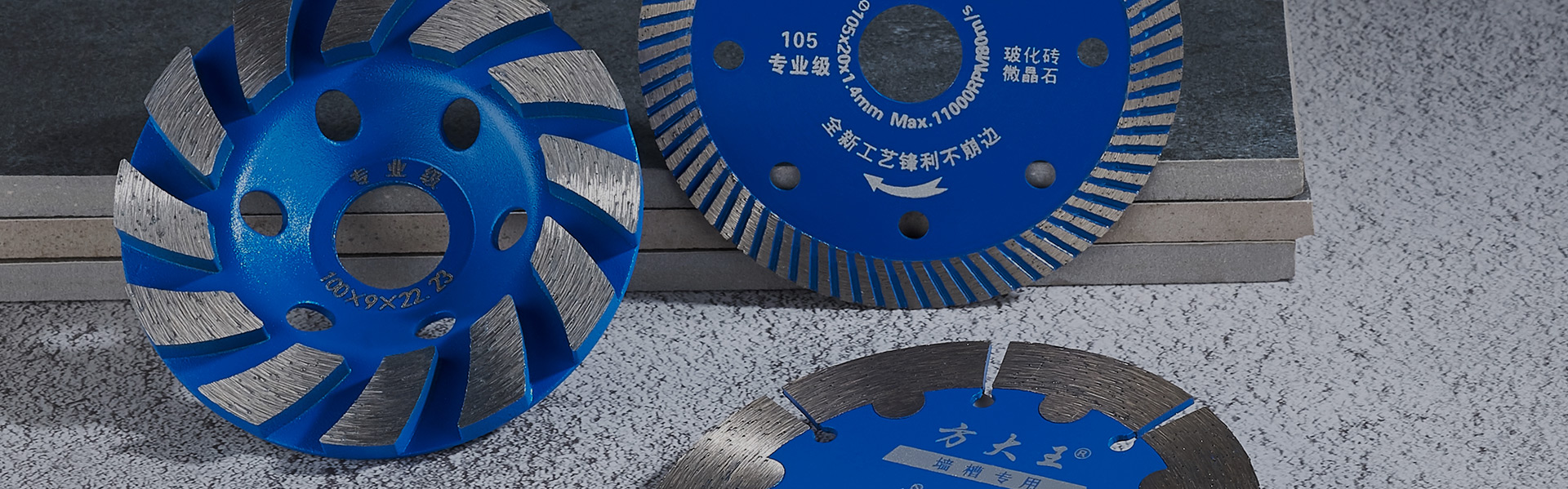
Suitable For Cutting Various Hard Processed Stone, Non-Metallic Materials.
APPLICATION:
STONE
CONCRETE
CERAMIC
VITREOUS TILE
Anyone sourcing diamond cutting tools for tile, stone, or concrete work has probably come across thin turbo blades. They are one of the more commonly stocked products in building material stores, hardware distributors, and professional tool supply channels because they can handle a wide range of cutting jobs without requiring multiple blade types.
At Fangda, these blades are supplied to importers, wholesalers, and private-label tool brands looking for a practical cutting solution for construction and renovation markets.
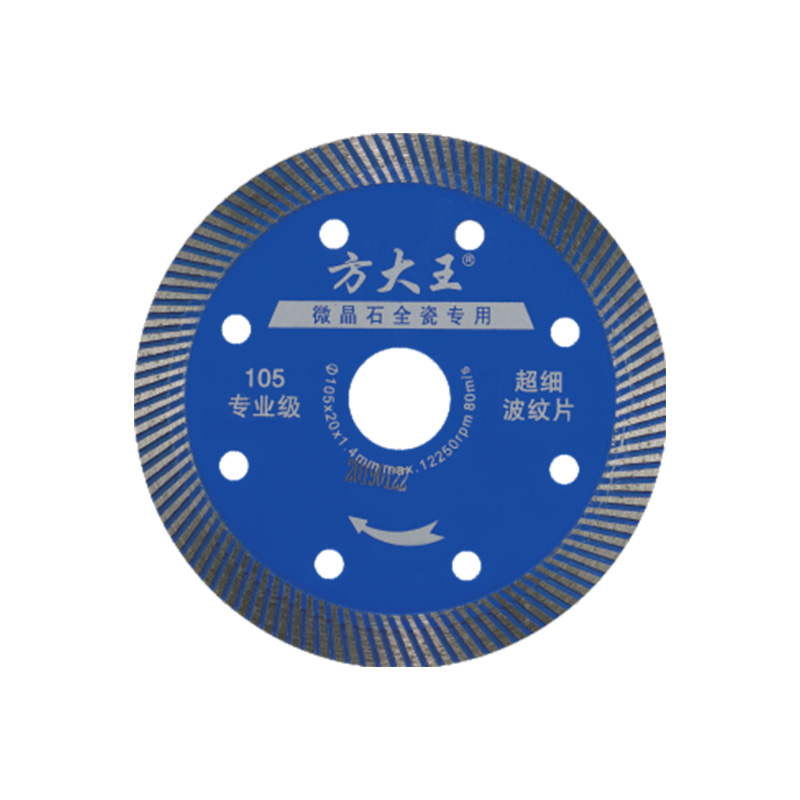
A thin turbo blade is easy to recognize. The rim is continuous but includes a wave-like turbo pattern around the edge. Combined with a thinner steel body, the design helps the blade move through material with less resistance than many traditional cutting discs.
On job sites, operators often use this type of blade when cutting ceramic tile, porcelain, brick, concrete products, artificial stone, and natural stone materials. The goal is usually straightforward: obtain a reasonably clean cut while maintaining acceptable cutting speed.
Different markets may use these blades in different ways. Tile installers may focus on edge quality, while construction contractors often pay more attention to productivity and blade life.
Most buyers do not ask where the diamonds come from, but they do care about consistency.
Industrial synthetic diamond is commonly used in modern diamond blade production because it offers stable performance and predictable quality. These diamond particles are mixed with metal powders to form the cutting section of the blade.
The steel body itself also plays an important role. Poor steel quality can lead to vibration, instability, or deformation during operation. For that reason, manufacturers generally select steel cores according to the intended cutting application.
Although diamond receives most of the attention, the balance between steel, bond materials, and diamond concentration often determines how a blade performs in real-world conditions.
Production starts long before packaging.
Raw materials are prepared first, followed by segment pressing and sintering. The cutting segments are then attached to the blade body through welding processes designed for industrial cutting tools.
After assembly, the blade goes through balancing, inspection, and dimensional checks. Finished products are packed according to customer requirements, which may range from simple bulk cartons to retail-ready blister cards.
For distributors purchasing large volumes, packaging is often nearly as important as the blade itself because damaged products during transportation create unnecessary costs.
Thin Turbo Diamond Cutting Blades are frequently found in:
Some customers purchase them for professional contractors, while others supply them through DIY retail channels.
Because one blade can be used across several material categories, distributors often include turbo blades as a standard item within their cutting tool product range.
Most purchasing discussions eventually come down to a few practical topics.
The first is lifespan. Buyers want to know how many cuts can reasonably be expected under normal conditions.
The second is pricing. Very low-cost blades exist in nearly every market, but repeat buyers usually focus on consistency rather than the lowest possible unit cost.
Another common question involves packaging. Some importers require branded retail packaging, while others prefer bulk supply for local repacking operations.
Lead time is also important. Construction tool distributors often need regular shipments throughout the year rather than a single seasonal order.
Many customers do not sell products under the factory name.
Instead, they build their own brands and require customized packaging, labeling, and product identification.
Fangda supports OEM and ODM projects covering:
Product specifications can also be adjusted for different market requirements and price segments.
Finding a Cutting Blades Manufacturer is usually not difficult. Finding one that can maintain consistent quality across repeated orders is often the bigger challenge.
For importers, wholesalers, and distributors, stability matters. Products need to arrive on time, specifications need to remain consistent, and packaging needs to match customer requirements.
As a Cutting Blades Supplier serving international markets, Fangda works with customers looking for practical solutions rather than one-time purchases. Whether the requirement is a standard Thin Turbo Diamond Cutting Blade or a private-label program, the focus remains the same: delivering products that fit the needs of the target market.

Demand for customized cutting tools has been climbing across a lot of manufactur...
Choosing the right router bit is a common consideration in woodworking productio...
In woodworking, the final appearance of a product is often decided by small deta...
For construction, woodworking and general workshop jobs, cutting neat holes isn'...

Industrial Zone, Furong Town, Yueqing City, Zhejiang Province, China


+86-0577-62298888
+86-0577-62299999

+86-0577-62295777
+86-0577-62297777
Copyright © Fangda Holding Co., Ltd. All Rights Reserved
Metal Drill Bit Sets Suppliers